Carbs Are Your Friend
Carbs Are Your Friend: When to Use Them Most Effectively (Even While Getting Leaner)
Carbs have been blamed for everything.
Weight gain. “Bloat.” Feeling soft. Cravings. A lack of discipline.
And because carbs are the easiest macro to spot (bread, rice, pasta, cereal, fruit), they have become the easiest one to demonize.
But carbs are not the villain.
Carbs are fuel. When you understand how they work, you can use them to support two goals that often feel like they compete:
Getting leaner (fat loss)
Training hard enough to keep strength and muscle
That is the entire point of this post and this article. Not avoiding carbs. Not worshipping carbs. Using carbs with intention.
In this guide, you will learn:
Why carbs got a bad reputation
What carbs actually do in your body
How carbs support training performance and recovery
How to use carbs while dieting without derailing fat loss
A simple “carb targeting” plan you can actually stick to

Carbs are fuel. The goal is to aim them where they help performance.
First, Let’s Kill the Biggest Myth: “Carbs Make You Fat”
Carbs do not automatically “turn into fat.”
Fat gain happens when your average intake stays above your average output for long enough. That can happen with carbs, fats, or a mix of both. The macro is not magic. The surplus is.
This is why someone can gain fat eating “clean carbs” and why someone else can lose fat eating carbs daily. The difference is usually total calories, consistency, and food choices.
A common reason people think carbs made them gain fat is the scale jump after increasing carbs. Most of the time, that is not fat gain. It is a mix of:
More food volume in the gut
More glycogen storage
More water stored along with that glycogen
Often more sodium (especially if the carbs are coming from convenience foods)
If you have ever increased carbs and gained 2 to 5 pounds quickly, there is a good chance most of that is water and glycogen, not fat. Research reviews commonly cite that each gram of glycogen is stored with at least about 3 grams of water, which can shift body weight quickly when carbohydrate intake changes (PMID: 29963728).
The mistake is letting a normal scale shift convince you that carbs “do not work for you.”
The Real Question: Can You Get Lean While Keeping Carbs?
Yes.
A major 12-month randomized trial compared a “healthy low-fat” diet to a “healthy low-carb” diet and found no significant difference in weight change between groups at 12 months (PMID: 29466592).
What does that mean in real life?
It means fat loss is not owned by one macro split. It is owned by:
A sustainable calorie intake
Enough protein
Consistent training
Food quality you can repeat
A plan you can stick to on normal weeks, not just “perfect” weeks
So if you like carbs, you do not need to cut them just because fat loss is the goal.
You need a better strategy than “carbs are bad.”

Carb-rich foods including rice, potatoes, oats, and whole grain toast
What Carbs Actually Do (In Plain English)
Carbs are your body’s preferred fuel source for higher-intensity work.
When you eat carbs, your body breaks them down into glucose. That glucose can be:
Used immediately for energy
Stored in the liver and muscle as glycogen
Converted and stored as fat if you consistently eat more energy than you burn
The key training takeaway is this:
Muscle glycogen is one of the major fuels for hard work. That matters most when training is higher volume, more intense, or longer duration.
If glycogen is lower, you can still train. You might just reach fatigue sooner, feel “flat,” or struggle to keep output as high from set to set, especially in demanding sessions.
This is why carbs are often the first macro that makes training feel better when someone has been under-fueling.
Why Carbs Can Help You Get Leaner
When people diet, they usually think the goal is only to lose weight.
But if you are training, the better goal is:
Lose fat while keeping muscle, strength, and performance as high as possible.
Carbs can help with that because they can support:
Better performance and training quality
Higher total training volume
Better recovery between sessions
Better adherence for many people (less “all or nothing” dieting)
If carbs help you keep training strong while calories are lower, carbs are supporting fat loss indirectly because your training stays productive.
This is also why sports nutrition position stands and recovery literature emphasize the role of carbohydrate timing and total energy availability around harder training blocks (PMID: 28919842).
The “Scale Jump” That Freaks People Out: Glycogen and Water
Let’s hit this head-on because it causes a lot of unnecessary stress.
If you increase carbs, it is normal to see the scale rise quickly.
That does not automatically mean fat gain.
Glycogen is stored with water. So when glycogen stores rise, water rises too. Reviews commonly cite at least roughly 3 grams of water per gram of glycogen (PMID: 29963728). That is enough to shift scale weight quickly.
This is why:
Low carb diets often show rapid early scale drops
Higher carb phases can make you look “fuller” in the muscles
A weekend of higher carbs can show up on the scale for a few days
None of that is moral. None of that is failure. It is normal physiology.
The better way to judge progress is your weekly trend, not your day-to-day fluctuations.
The Most Practical Strategy: Carb Targeting
If you want a simple approach that works for busy adults, start here.
The Rule
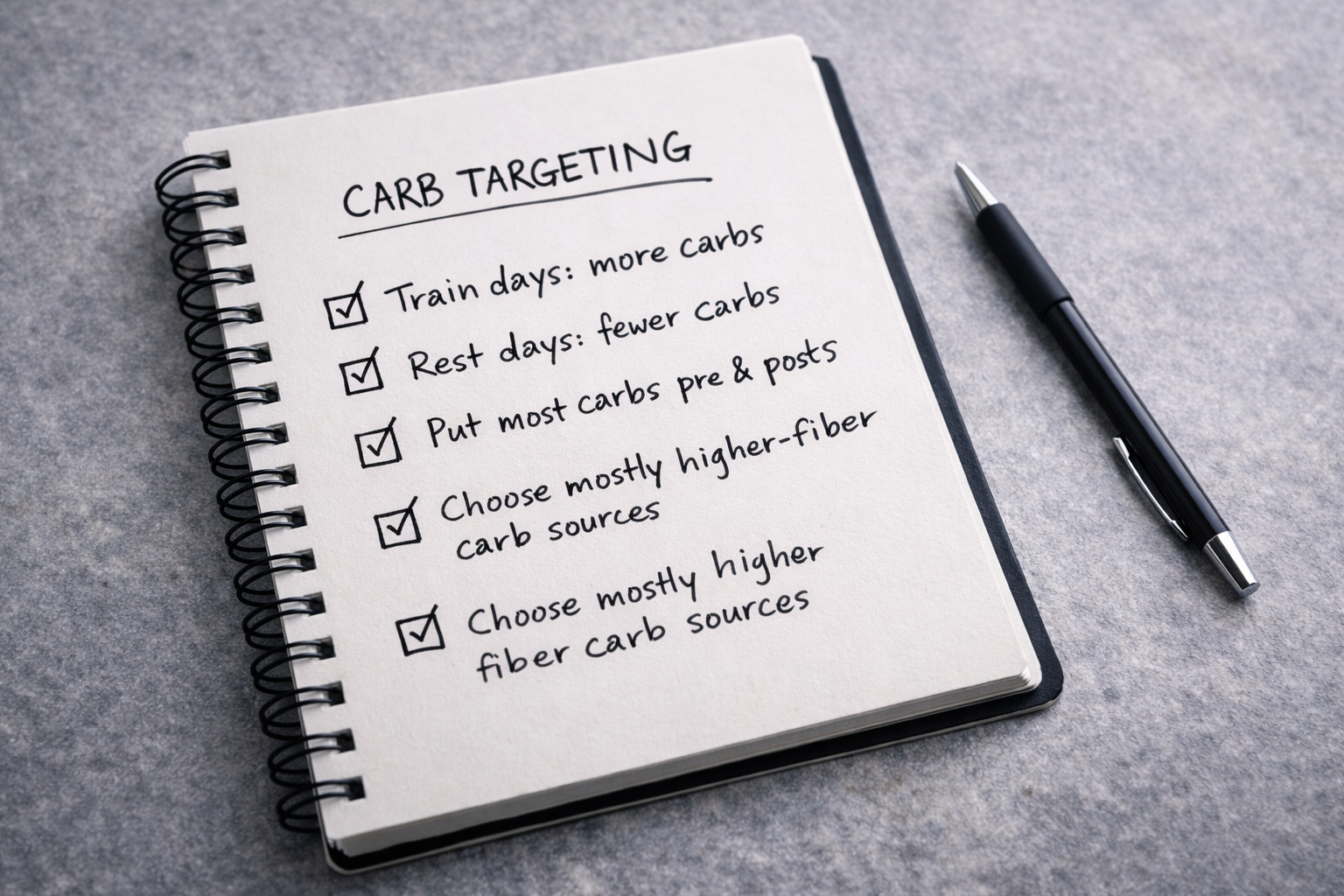
Train days: more carbs
Rest days: fewer carbs
Protein stays high either way
This is not magic. It is a way to place carbs where they matter most and reduce them where they matter less.
The goal is to keep weekly calories controlled while keeping training performance high.
Carb targeting also helps people avoid the most common dieting pattern:
Going very low carb all week, cravings build, and then the weekend becomes a blowout.
Carb targeting is a stability strategy. It keeps you fueled enough to train well and consistent enough to lose fat.

When Carbs Matter Most
Carbs matter more when training is:
Higher volume (more hard sets)
Longer sessions
More metabolically demanding (supersets, circuits, density work)
Conditioning-heavy
Carbs tend to matter less when the day is:
A rest day
A low intensity day (easy walking, mobility, light cardio)
A shorter, low volume lift
This does not mean you cannot eat carbs on rest days.
It means you probably do not need as many carbs on rest days to support performance.
Pre-Workout Carbs: When They Help
Pre-workout carbs can be useful when:
You train early
You train fasted or after a long gap without food
Your sessions feel flat or sluggish
The training is long, hard, or conditioning-heavy
A simple pre-workout guide
If you train within 0 to 2 hours, choose something easy to digest:
Banana + Greek yogurt
Small bowl of oats + whey
Rice cakes + honey or jam
Cereal + milk if you tolerate it well
If you already ate a solid meal 2 to 4 hours earlier, you may not need a special pre-workout carb snack. Your last meal might be doing the job.
If your goal is performance in longer training or endurance-style sessions, carbohydrate feeding strategies during exercise are well supported in the literature for improving endurance capacity and performance (PMID: 15212750).

Carbs During Training: Who Actually Needs Them?
Most people lifting for 45 to 75 minutes do not need intra-workout carbs.
But they can help when:
Sessions are very long (often 90+ minutes)
You are doing hard conditioning or intervals
You are training twice in a day
You are in a high-volume block and struggling to recover
Again, the best evidence for intra-workout carbs is in endurance contexts and longer duration exercise, where carbohydrates can improve performance and time to exhaustion (PMID: 15212750).
Post-Workout Carbs: The Real Purpose (Recovery)
Post-workout carbs matter most when:
You train again later the same day
You train early the next morning
You are in a high-volume phase
You are doing a lot of conditioning
Why?
Carbs help replenish glycogen stores.
Classic work by Ivy and colleagues shows that delaying carbohydrate intake after exercise can reduce the rate of muscle glycogen storage (PMID: 3132449) and that sufficient carbohydrate intake strategies can support a rapid rate of glycogen resynthesis after exercise (PMID: 9694422).
Do you need carbs within 10 minutes of finishing your workout?
No.
But if you train hard and train frequently, a normal post-workout meal with protein and carbs is one of the simplest recovery wins you can make.
Carb Quality: The “Getting Lean” Upgrade
Carbs are a dial. Food quality is the steering wheel.
When people say “carbs make me gain weight,” the real problem is often the type of carbs being chosen:
Ultra-processed snack foods
Desserts and liquid calories
“Carb foods” that are very easy to overeat
If fat loss is your goal, a better base is:
Fruit
Potatoes
Rice
Oats
Beans and lentils
Whole grains you tolerate well
Why fiber helps
Higher fiber intake is associated with better satiety and reduced appetite and energy intake in many contexts. A systematic review on fiber and satiety discusses which fiber types and doses are most effective for reducing appetite and energy intake (PMID: 23885994).
Translation:
If dieting feels brutal, improving carb quality and increasing fiber is often one of the easiest fixes.
Carb Targeting Templates You Can Use This Week
Here are practical templates you can use immediately.
Template A: Train Day (Strength Session)
Meal 1: Protein + carbs + fruit
Example: Greek yogurt + oats + berries
Meal 2 (optional pre-workout): Light carb + protein
Example: banana + whey
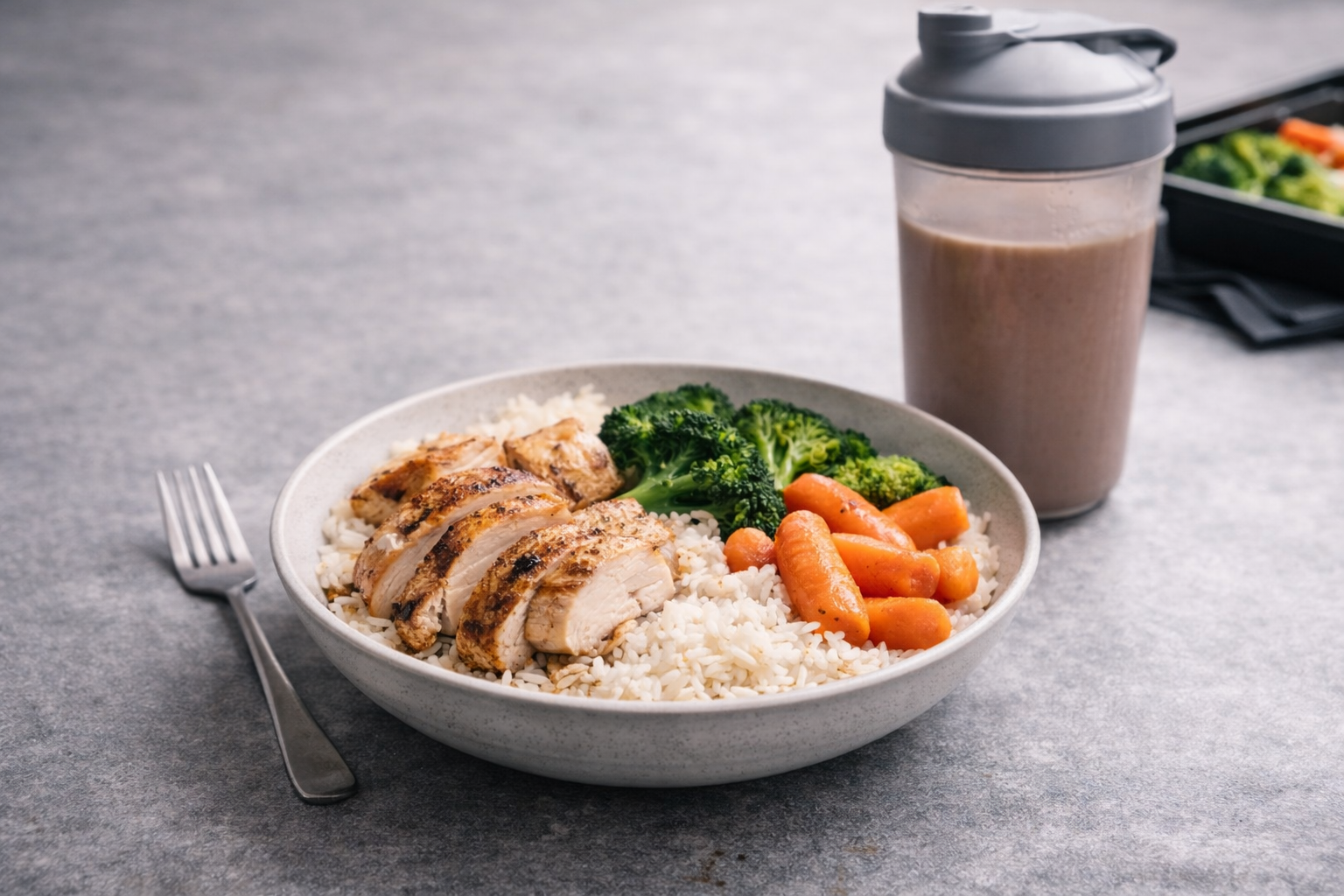
Meal 3 (post-workout): Protein + carbs + veg
Example: chicken + rice + broccoli
Meal 4: Protein-focused, carbs based on needs
Example: eggs and potatoes, or a higher-veg meal if calories are tight
Template B: Rest Day (Steps, Mobility, Life)
Meal 1: Protein + fiber
Example: eggs and spinach + berries
Meal 2: Protein + veg + healthy fat
Example: salad bowl with chicken, beans, avocado
Meal 3: Protein + veg
Example: salmon + roasted vegetables
Snack (optional): Protein first
Example: shake, Greek yogurt, cottage cheese
Notice what stays consistent:
Protein stays high
Food quality stays high
Carbs shift based on training demand
Common Problems and How to Fix Them
“Carbs make me hungry.”
Usually one of two things:
Low fiber, highly processed carb sources
Carbs replaced protein and fiber in the meal
Fix:
Keep protein steady
Choose higher fiber carb sources
Build meals, not snack chains
“I feel flat and weak while dieting.”
Often you are under-fueling training days.
Fix:
Increase carbs around training
Consider slightly higher calories on training days and slightly lower on rest days (keep weekly calories controlled)
Prioritize sleep and hydration
“The scale is not moving.”
Carbs are not automatically the issue.
Fix:
Check weekly average calories
Check weekends and liquid calories
Confirm protein intake
Confirm training consistency
What About Low Carb Diets?
Low carb diets can work, and some trials show greater short-term weight loss compared to low fat diets in certain contexts (PMID: 12679447).
The bigger question is whether you can maintain it while training hard and living like a normal human.
For many people, a moderate approach that includes carbs, prioritizes quality, and targets carbs around training is more sustainable.
The Iron Camp Takeaway
Carbs are not the enemy of getting lean. Misusing them is.
If you want the simplest checklist possible:
Save This Carb Targeting Checklist
Train days: more carbs
Rest days: fewer carbs
Put most carbs pre and post workout
Choose mostly higher fiber carb sources
Keep protein high daily
If you do that consistently, carbs stop being a stress point and start being a tool.
FAQ
Do I need carbs at every meal?
No. Many people do best placing most carbs around training and keeping other meals more protein and veg focused.
Are carbs bad at night?
No. Total daily intake matters most. Some people even sleep better with carbs at dinner.
How do I know if I’m eating the right amount of carbs?
Your training performance, recovery, hunger, and weekly weight trend will tell the truth. If training is falling apart, you may need more carbs on training days. If the weekly trend is not moving for weeks, total calories may be too high.
References
Gardner CD, et al. Effect of Low-Fat vs Low-Carbohydrate Diet on 12-Month Weight Loss in Overweight Adults (DIETFITS). JAMA. 2018. PMID: 29466592
Ivy JL, et al. Muscle glycogen synthesis after exercise: effect of time of carbohydrate ingestion. J Appl Physiol. 1988. PMID: 3132449
Ivy JL. Glycogen resynthesis after exercise: effect of carbohydrate intake. Int J Sports Med. 1998. PMID: 9694422
Kerksick CM, et al. International Society of Sports Nutrition position stand: nutrient timing. J Int Soc Sports Nutr. 2017. PMID: 28919842
Jeukendrup AE. Carbohydrate intake during exercise and performance. Nutrition. 2004. PMID: 15212750
Clark MJ, Slavin JL. The effect of fiber on satiety and food intake: a systematic review. J Am Coll Nutr. 2013. PMID: 23885994
Murray B, Rosenbloom C. Fundamentals of glycogen metabolism for coaches and athletes. Nutr Rev. 2018. PMID: 29963728
Brehm BJ, et al. A randomized trial comparing a very low carbohydrate diet and a low fat diet on body weight and cardiovascular risk factors in healthy women. J Clin Endocrinol Metab. 2003. PMID: 12679447
