You Don’t Need More Cardio
You Don’t Need More Cardio
You Need This First
If you are reading this, there is a good chance you have said some version of this before:
• “I just need to do more cardio.”
• “I have to get my conditioning up.”
• “I’m going to start running again so I can lean out.”
• “I’m going to add the StairMaster after lifting.”
Sometimes that is true.
Most of the time, it is not.
Most people do not have a cardio problem. They have a foundation problem. They are trying to solve a consistency, strength, nutrition, recovery, and daily movement issue with more sweat.
And it makes sense why.
Cardio is measurable. You can track minutes, miles, calories, and heart rate. It feels productive immediately. It also gives you that psychological “I did something” feeling, especially if you are frustrated with your body, your energy, or the scale.
But here is the hard truth:
If your training feels like you are always starting over, if your body feels beat up, if your weight loss is stuck, if your back hurts, if your knees hate you, if you are tired all day, or if you do cardio “consistently” and still do not look or feel the way you want, then adding more cardio is usually just adding more noise.
You need a base.
With the Iron Camp Method, we coach a simple idea:
Strong basics first.
Cardio second.
Cardio is not the first lever you pull.
Cardio is a multiplier once the basics are in place.
This post will show you what to do first, why it works, and how to build it into a sustainable plan that fits real life.
Why You Think You Need More Cardio
Before we talk solutions, let’s diagnose the pattern. Most people reach for “more cardio” for one of five reasons:
1) You want fat loss
You are chasing the calorie burn. You want the scale to move. You want to feel like you earned your food.
2) You feel out of shape
Walking up stairs feels harder than it should. You get winded easily. You assume the fix is more intense cardio.
3) You do not trust strength training to “lean you out”
You might lift, but you do not believe it “counts” unless you finish drenched.
4) You have limited time
Cardio feels like the most efficient choice when your schedule is tight.
5) You want to “cancel out” lifestyle chaos
Stressful week, missed meals, poor sleep, too much takeout, and now you want to sweat it out on the weekend.
Here is the issue.
Cardio can help with all of those. But it is often the wrong starting point because it does not address the real bottleneck.
If you want your body to change, you need:
• a training stimulus strong enough to force adaptation,
• lifestyle structure that supports recovery,
• daily movement that keeps your energy output stable.
Cardio can support that. It cannot replace it.
Quick Clarity — Cardio Is Not Bad
This is not an anti-cardio post.
Cardio is valuable for heart health, work capacity, mood, and longevity. Major public health guidelines recommend regular aerobic activity plus muscle-strengthening work (at least 2 days per week). [1–3]
So yes, cardio matters.
But the question is not “Is cardio good?”
The question is: What do you need first, based on your current reality?
If you are under-muscled, inconsistent, sedentary outside the gym, not sleeping, not eating enough protein, and not progressing your training, your best first move is not to add more cardio.
Your best first move is to build the base.
The Foundation Most People Skip
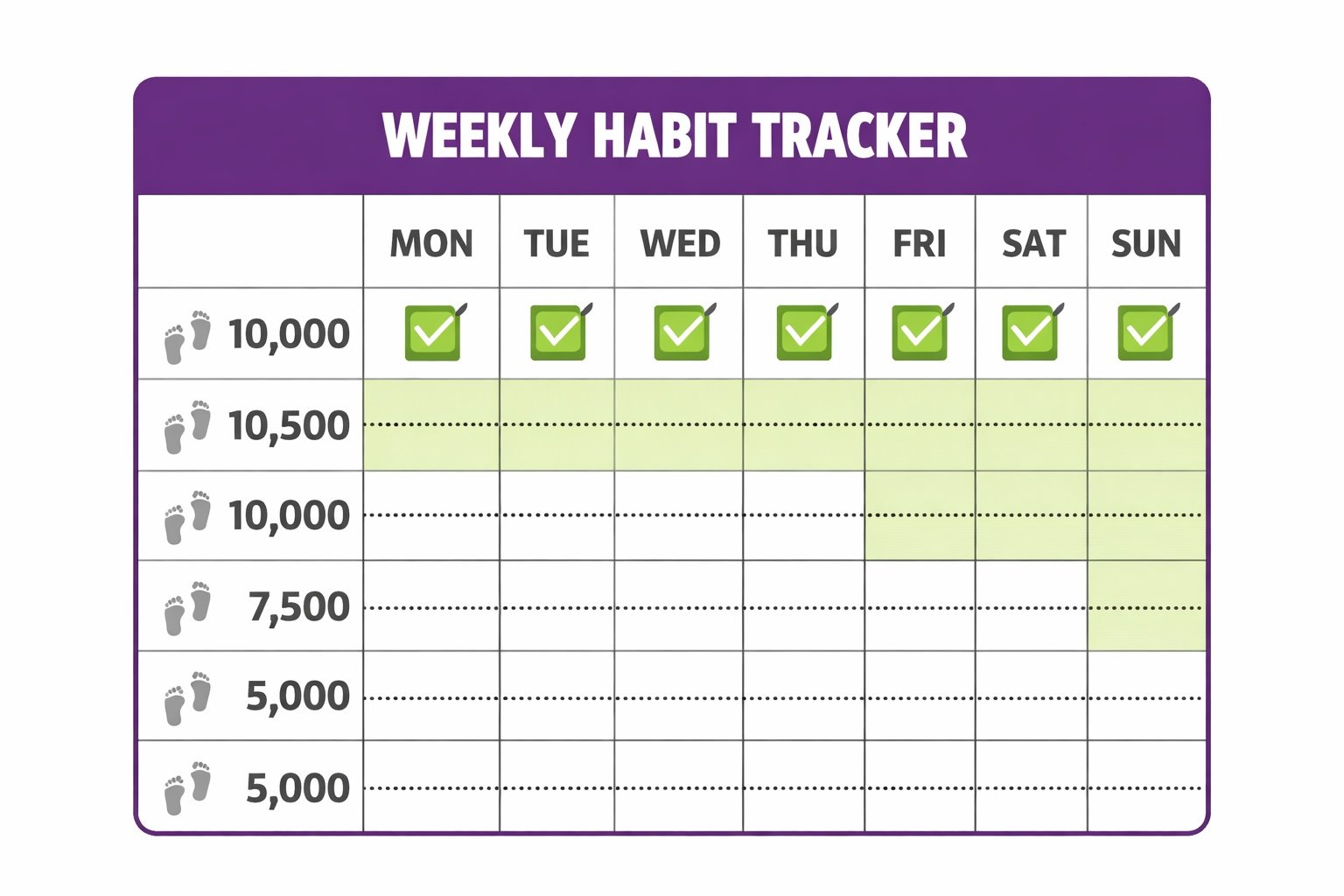
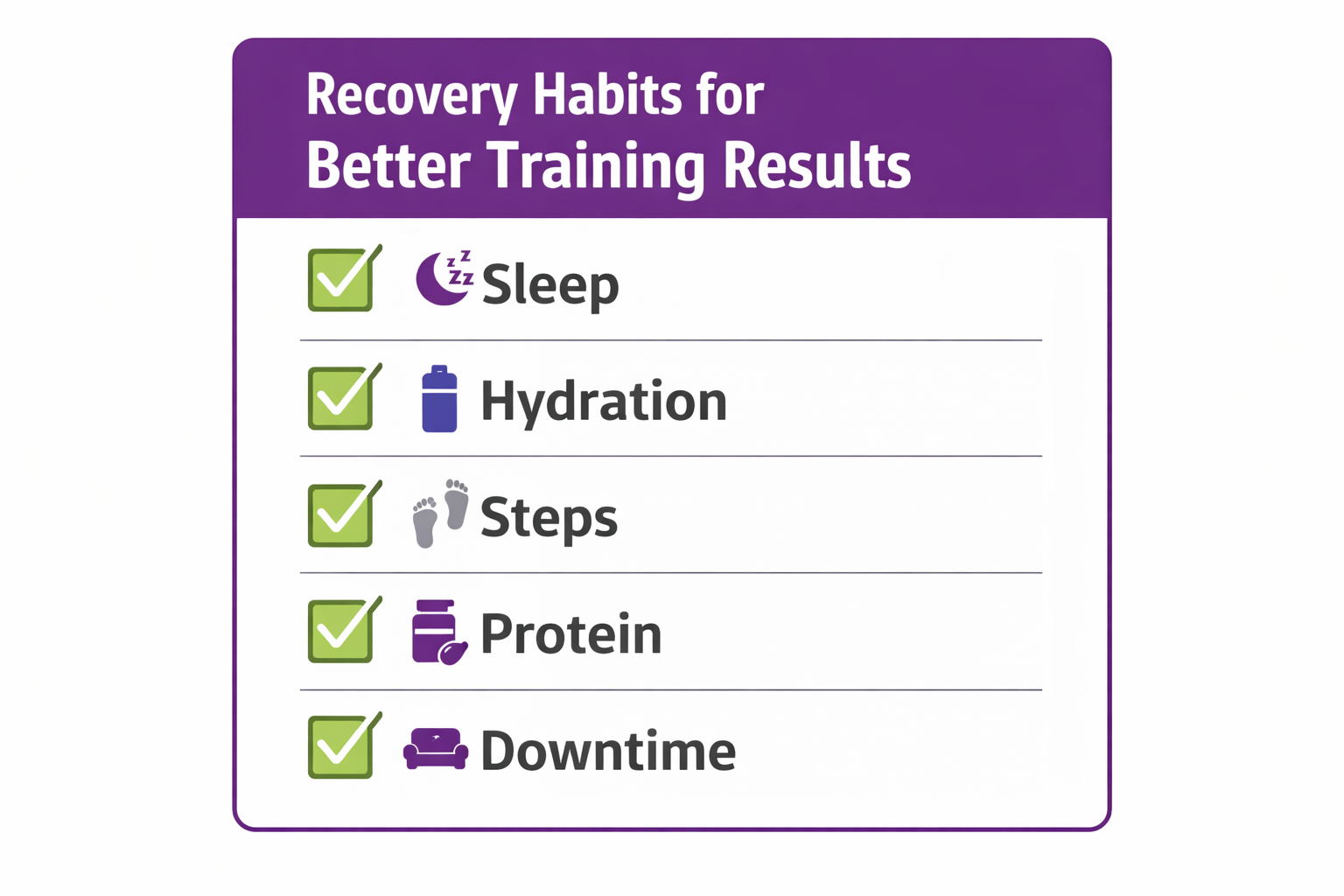
When we say “you need this first,” we mean four fundamentals that drive most body composition, performance, and longevity outcomes:
1) Strength training that progresses
2) Daily movement (steps + NEAT)
3) Nutrition basics (protein, calories, consistency)
4) Recovery (sleep, stress, and sustainable volume)
Cardio fits into the plan after those are addressed, not because cardio is unimportant, but because cardio works best when it is added to a system that can handle it.
Let’s break this down.
1) Strength Training Is the Anchor
If you want to change your body, strength training is not optional. It is the anchor.
Why strength training comes first
Strength training does at least four things that “more cardio” does not do as well:
A) It builds and preserves muscle
Muscle is not just aesthetics. It is function, joint stability, glucose disposal, metabolic health, and resilience.
If you diet without strength training, you increase the odds that the scale goes down but your body does not look better, feel better, or perform better. You lose some fat, but you also lose lean tissue.
B) It raises your “floor”
Most people think cardio raises their fitness ceiling. Strength raises your floor.
When you are stronger:
• daily tasks feel easier
• posture improves
• joints feel more stable
• you tolerate more activity
• you recover better from life
That changes everything.
C) It supports metabolic health
Resistance training has been shown to improve insulin resistance markers in adults with overweight/obesity. [10]
That matters because many people trying to “do more cardio” are also dealing with fatigue, blood sugar issues, and inconsistent habits.
D) It gives you a measurable progression system
Cardio is easy to “do.” It is harder to structure.
Strength training gives you clear targets:
• add a rep
• add a little load
• improve technique
• increase total quality sets
This creates momentum and buy-in.
How much strength training do you need?
You do not need to lift six days a week.
A practical baseline for most adults is:
• 2–4 strength sessions per week
• full-body or upper/lower structure
• progressive overload over time
Public health guidelines consistently include muscle-strengthening at least two days per week. [1–3]
For hypertrophy, higher weekly set volume tends to produce more growth up to a point, with dose-response patterns shown in meta-analytic research. [6]
The point is not maximum volume.
The point is enough quality work, consistently, with a progression plan.
2) Your Real “Cardio Problem” Is Often a Steps Problem
Here is the part most people miss.
They do 30–45 minutes of cardio a few times a week, but outside of that they are mostly sedentary. Desk job, commuting, long sitting blocks, low movement on off days.
So the overall weekly energy output stays low.
This is where NEAT matters.
NEAT = non-exercise activity thermogenesis (the energy you spend doing everything that is not formal exercise). [4–5]
Classic research showed huge individual differences in NEAT response and how strongly it can impact fat gain during overfeeding. [4]
Translation: two people can train similarly, eat similarly, and differences in daily movement can still decide the outcome.
Steps are the simplest lever
You do not need a fancy tracker. But step targets create structure.
More daily steps are associated with meaningful health benefits and lower mortality risk in large cohort studies. [12]
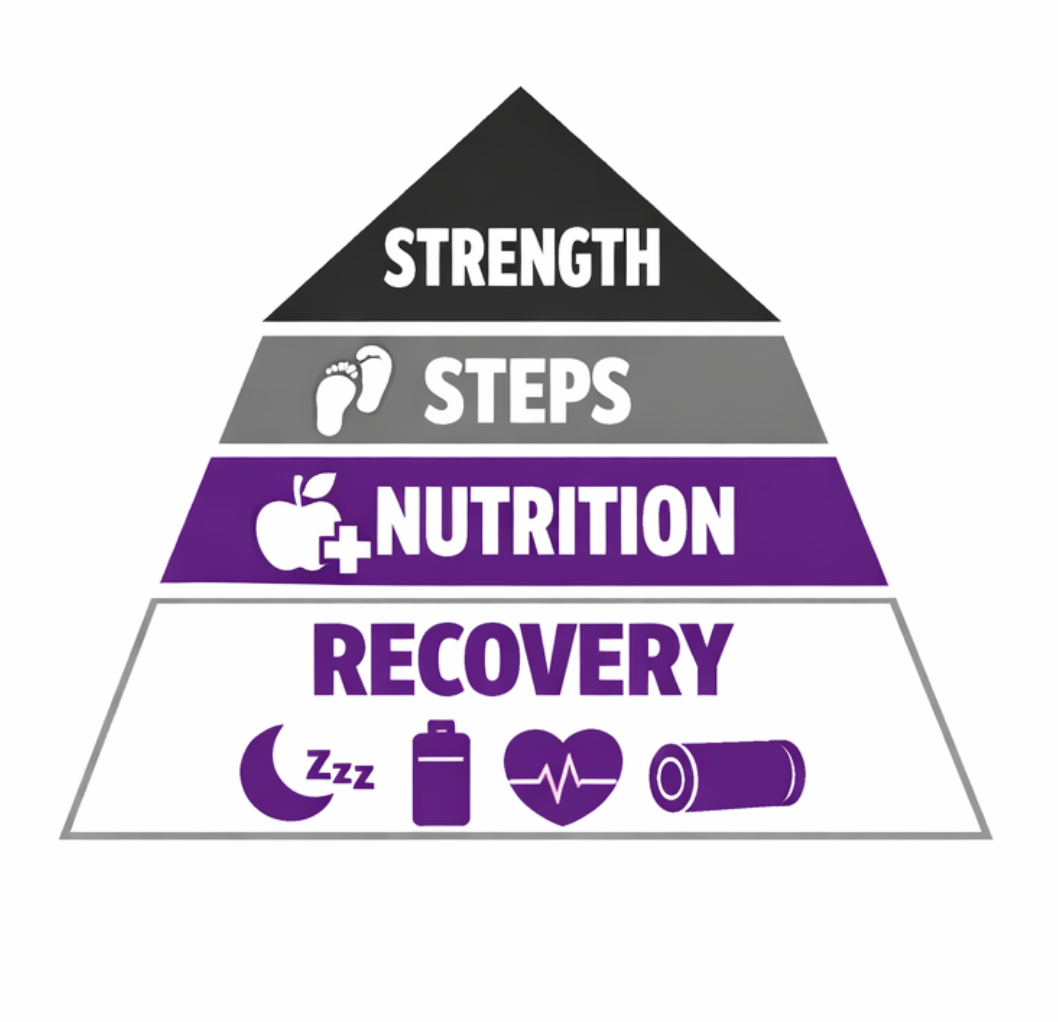
For most people, a realistic progression looks like:
• start where you are
• add 1,000–2,000 steps per day
• build toward a consistent range you can maintain
If you currently average 3,000 steps, jumping to 10,000 overnight is not the move.
But going from 3,000 to 5,000, then 6,500, then 7,500 is doable and changes outcomes fast because it changes your weekly baseline.
Why steps beat “random extra cardio”
Steps are low impact, low fatigue, and repeatable.
If you add more intense cardio without fixing daily movement, you often create:
• more hunger
• more fatigue
• worse strength training quality
• worse recovery
• higher dropout risk
Steps create a foundation that does not steal from your lifting.
3) Nutrition Basics Beat More Cardio for Fat Loss
If fat loss is your main goal, this is the uncomfortable reality:
You cannot out-cardio a nutrition problem.
Even worse, “more cardio” can hide the problem temporarily, then it rebounds:
• you push hard for a few weeks
• hunger rises
• recovery drops
• you miss sessions
• you feel like you failed
You did not fail. The plan was fragile.
The non-negotiables
You do not need a perfect meal plan.
You need consistency in a few key behaviors.
A) Protein
Protein supports lean mass retention during dieting and improves outcomes during resistance training.
A major meta-analysis found benefits of protein supplementation during resistance training, with diminishing returns beyond roughly ~1.6 g/kg/day in that context. [11]
Practical starting point:
• include a solid protein serving at every meal
• prioritize protein at breakfast
• aim for protein consistency before you chase calorie burn
B) Calories and your food environment
In a controlled inpatient trial, ultra-processed diets led to higher calorie intake and weight gain compared to unprocessed diets, even when meals were designed to be matched for presented calories and key nutrients. [9]
This matters because many people increase cardio, but their food choices become more ultra-processed because they are busy, stressed, and tired.
The “first” move is often:
• reduce friction for higher-quality meals
• improve meal structure
• stop relying on cardio to compensate
C) Consistency beats intensity
If you can be perfect for 10 days and then fall apart, you do not need more cardio.
You need a plan you can execute for 10 months.
That means:
• simple meals
• repeatable grocery lists
• a protein-first default
• a realistic schedule for training
4) Recovery Is the Hidden Constraint
Many people try to solve fatigue with more training. That is backward.
If you are already under-recovered, adding more cardio is like adding more volume to a system that is already overloaded.
Sleep affects appetite and decision-making
Experimental sleep restriction has been linked to increases in ghrelin and higher calorie intake, which can make fat loss harder and cravings stronger. [13]
If you are sleeping 5–6 hours a night, your problem is not cardio volume.
Your problem is recovery and appetite regulation.
Stress changes behavior
Stress does not just change hormones. It changes:
• food choices
• impulse control
• movement habits
• training quality
• cravings
When stress is high, your plan needs to get simpler, not harder.
The Iron Camp rule
If you want results you can keep, your training volume must match your recovery capacity.
That is why we prioritize:
• strength sessions you can repeat weekly
• daily movement that supports energy output
• cardio that does not cannibalize lifting quality
So What Do You Need First?
Here is the Iron Camp answer in one sentence:
You need a strength and movement base that makes cardio optional, not necessary for progress.
That looks like:
1) 2–4 days per week of progressive strength training
2) An activity target you actually hit most days
3) Protein-forward meals and a realistic calorie structure
4) Sleep and recovery that supports consistency
Once those are in place, cardio becomes a tool, not a punishment.
Where Cardio Fits After You Build the Base
Now we add cardio with intent.
Cardio for health
General guidelines support regular aerobic activity, paired with strength training. [1–3]
Cardio for performance
If you play sports, chase athletic goals, or want better conditioning for lifting sessions, cardio supports work capacity.
Cardio for fat loss
Cardio can help increase energy expenditure, but it works best when it does not disrupt strength training, steps, and nutrition.
Practical cardio placement
For most busy adults:
• Start with Zone 2 style work (incline walk, bike, rower at conversational pace)
• Add 1–3 sessions per week
• Keep it short and repeatable (20–35 minutes)
• Avoid turning every session into a max-effort test
If you lift 3 days per week, add 2 Zone 2 sessions, and hit daily steps, you have a complete program.
You do not need seven cardio sessions.
A Simple 4-Week “Do This First” Plan
This is a practical template you can use immediately.
The goal for the next 4 weeks
• Build consistency
• Progress strength
• Raise baseline movement
• Improve recovery habits
• Add cardio only as support
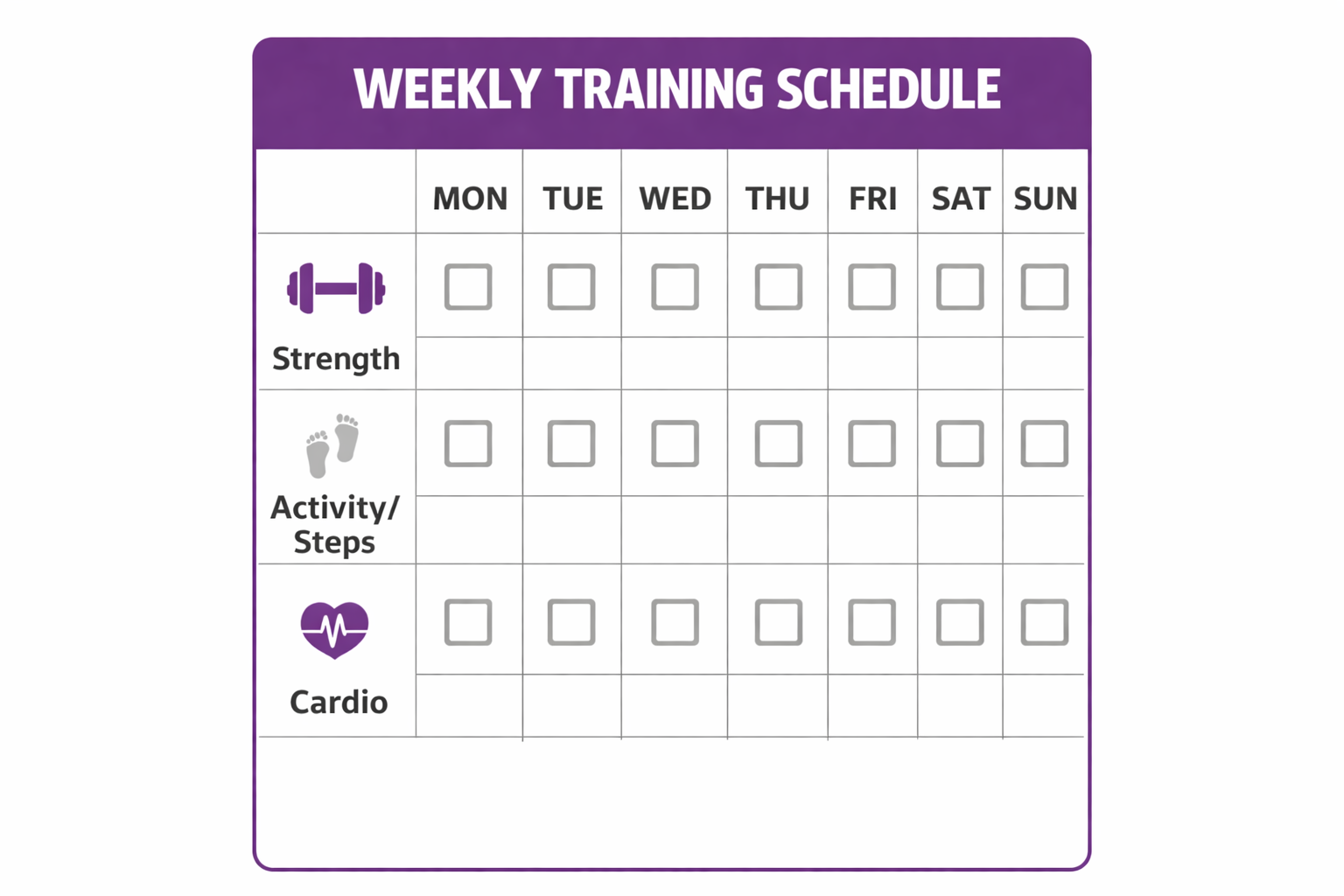
Weekly targets
• Strength: 3 sessions per week (full-body or upper/lower split)
• Activities: pick 1 or 2 non strength training activities (e.g., pilates, yoga or golf) or increase weekly average by 1,000–2,000 steps/day from baseline
• Cardio: 2 Zone 2 sessions (optional in Week 1 if you are very under-recovered)
• Nutrition: protein at every meal, plus one default dinner you can repeat
• Recovery: target 7+ hours in bed, plus a 30-minute shutdown routine
Week-by-week progression
Week 1: Stabilize
• Strength: 3 sessions
• Activity/Steps: baseline + 1,000/day
• Cardio: 1–2 easy Zone 2 sessions
• Focus: show up, leave reps in the tank, do not chase soreness
Week 2: Build
• Strength: add a rep or small load where form is strong
• Activity/Steps: baseline + 1,500/day
• Cardio: 2 Zone 2 sessions
• Focus: consistency, not intensity
Week 3: Progress
• Strength: slightly more total work (one extra set for 1–2 lifts)
• Activity/Steps: baseline + 2,000/day
• Cardio: 2 Zone 2 sessions
• Focus: better training quality, not longer sessions
Week 4: Consolidate
• Strength: repeat Week 3 loads or reps
• Activity/Steps: hold steady
• Cardio: 2 Zone 2 sessions
• Focus: make this feel normal
At the end of 4 weeks, you will have data:
• strength numbers
• step averages
• recovery quality
• consistency rate
That is what you build on.
Common Mistakes That Make People Think They “Need More Cardio”
Mistake 1: Training hard but not progressing
If you do random workouts with no progression plan, you plateau and blame cardio.
Mistake 2: Too much intensity, not enough structure
If every session is max effort, you burn out and think you need a new hack.
Mistake 3: Doing cardio to compensate for inconsistent eating
That turns training into punishment. It also usually fails long term.
Mistake 4: Ignoring daily movement
You do not need another HIIT session. You need to stop being sedentary for 10–12 hours a day.
Mistake 5: Under-eating protein, under-sleeping, and overtraining
That combo will make you feel out of shape no matter how much cardio you do.
The Iron Camp Method — Make Cardio Strategic
With the Iron Camp Method, the goal is not to eliminate cardio. The goal is to make it strategic.
Here is the framework:
1) Strength first
2) Steps daily
3) Protein and meal structure
4) Sleep and recovery
5) Cardio as support, not the main event
When you do that, cardio becomes something you add for:
• heart health
• performance
• conditioning
• enjoyment
Not something you rely on to fix everything.
Who Actually Should Do More Cardio Right Now?
There are people who should increase cardio sooner, including:
• people with very low aerobic capacity who cannot walk briskly for 10–15 minutes
• athletes prepping for sport demands
• people whose main goal is endurance performance
• those who already lift consistently, hit steps, eat well, and recover reasonably
If you are not in that group, start with the base.
Final Takeaway
If you feel like you “need more cardio,” pause and ask:
• Am I strength training consistently with progression?
• Am I moving enough outside the gym?
• Am I eating enough protein and controlling the basics?
• Am I sleeping and recovering enough to support consistency?
If the answer is no, cardio is not the missing piece.
You do not need more cardio.
You need the foundation first.
If you want a plan that builds strength, improves conditioning, and supports fat loss without burning you out:
• Iron Camp Base gives you structured training you can run consistently.
• Remote coaching (Trainerize) gives you programming, accountability, and adjustments based on your real life.
References
[1] World Health Organization. (2020). WHO guidelines on physical activity and sedentary behaviour. https://www.who.int/publications/i/item/9789240015128 (Accessed January 21, 2026)
[2] U.S. Department of Health and Human Services. (2018). Physical Activity Guidelines for Americans (2nd ed.). https://health.gov/sites/default/files/2019-09/Physical_Activity_Guidelines_2nd_edition.pdf (Accessed January 21, 2026)
[3] Centers for Disease Control and Prevention. (2023, December 20). Adult Activity: An Overview. https://www.cdc.gov/physical-activity-basics/guidelines/adults.html (Accessed January 21, 2026)
[4] Levine, J. A., Eberhardt, N. L., & Jensen, M. D. (1999). Role of nonexercise activity thermogenesis in resistance to fat gain in humans. Science, 283(5399), 212–214. https://doi.org/10.1126/science.283.5399.212
[5] Levine, J. A. (2004). Nonexercise activity thermogenesis (NEAT): Environment and biology. American Journal of Physiology-Endocrinology and Metabolism, 286(5), E675–E685. https://doi.org/10.1152/ajpendo.00562.2003
[6] Schoenfeld, B. J., Ogborn, D., & Krieger, J. W. (2017). Dose-response relationship between weekly resistance training volume and increases in muscle mass: A systematic review and meta-analysis. Journal of Sports Sciences, 35(11), 1073–1082. https://doi.org/10.1080/02640414.2016.1210197
[7] Shailendra, P., et al. (2022). Resistance training and mortality risk: A systematic review and meta-analysis. American Journal of Preventive Medicine, 63(2), 277–285. https://pubmed.ncbi.nlm.nih.gov/35599175/ (Accessed January 21, 2026)
[8] Momma, H., et al. (2022). Muscle-strengthening activities are associated with lower risk and mortality in major non-communicable diseases: A systematic review and meta-analysis of cohort studies. British Journal of Sports Medicine, 56(13), 755–763. https://bjsm.bmj.com/content/56/13/755 (Accessed January 21, 2026)
[9] Hall, K. D., et al. (2019). Ultra-processed diets cause excess calorie intake and weight gain: An inpatient randomized controlled trial of ad libitum food intake. Cell Metabolism, 30(1), 67–77.e3. https://www.cell.com/cell-metabolism/fulltext/S1550-4131(19)30248-7
[10] Boyer, W. R., et al. (2023). The role of resistance training in influencing insulin resistance among adults living with obesity/overweight without diabetes: A systematic review and meta-analysis. https://pubmed.ncbi.nlm.nih.gov/37331899/ (Accessed January 21, 2026)
[11] Morton, R. W., Murphy, K. T., McKellar, S. R., et al. (2018). A systematic review, meta-analysis and meta-regression of the effect of protein supplementation on resistance training-induced gains in muscle mass and strength in healthy adults. British Journal of Sports Medicine, 52(6), 376–384. https://doi.org/10.1136/bjsports-2017-097608
[12] Inoue, K., Tsugawa, Y., Mayeda, E. R., & Ritz, B. (2023). Association of daily step patterns with mortality in US adults. JAMA Network Open, 6(3), e235174. https://jamanetwork.com/journals/jamanetworkopen/fullarticle/2802810 https://doi.org/10.1001/jamanetworkopen.2023.5174
[13] Broussard, J. L., Kilkus, J. M., Delebecque, F., et al. (2016). Elevated ghrelin predicts food intake during experimental sleep restriction. Obesity, 24(1), 132–138. https://doi.org/10.1002/oby.21321
